The evidence is available as a twenty-two-page scan in the FBI Vault. On PDF page 16, a letter dated February 24, 1977 gives the laboratory result: deer-family hair. Page 21 holds photographs of the submitted material beside metric scales. A file called Bigfoot contains an answer about hair. The file name is considerably larger than the finding.
SOURCE MATERIAL
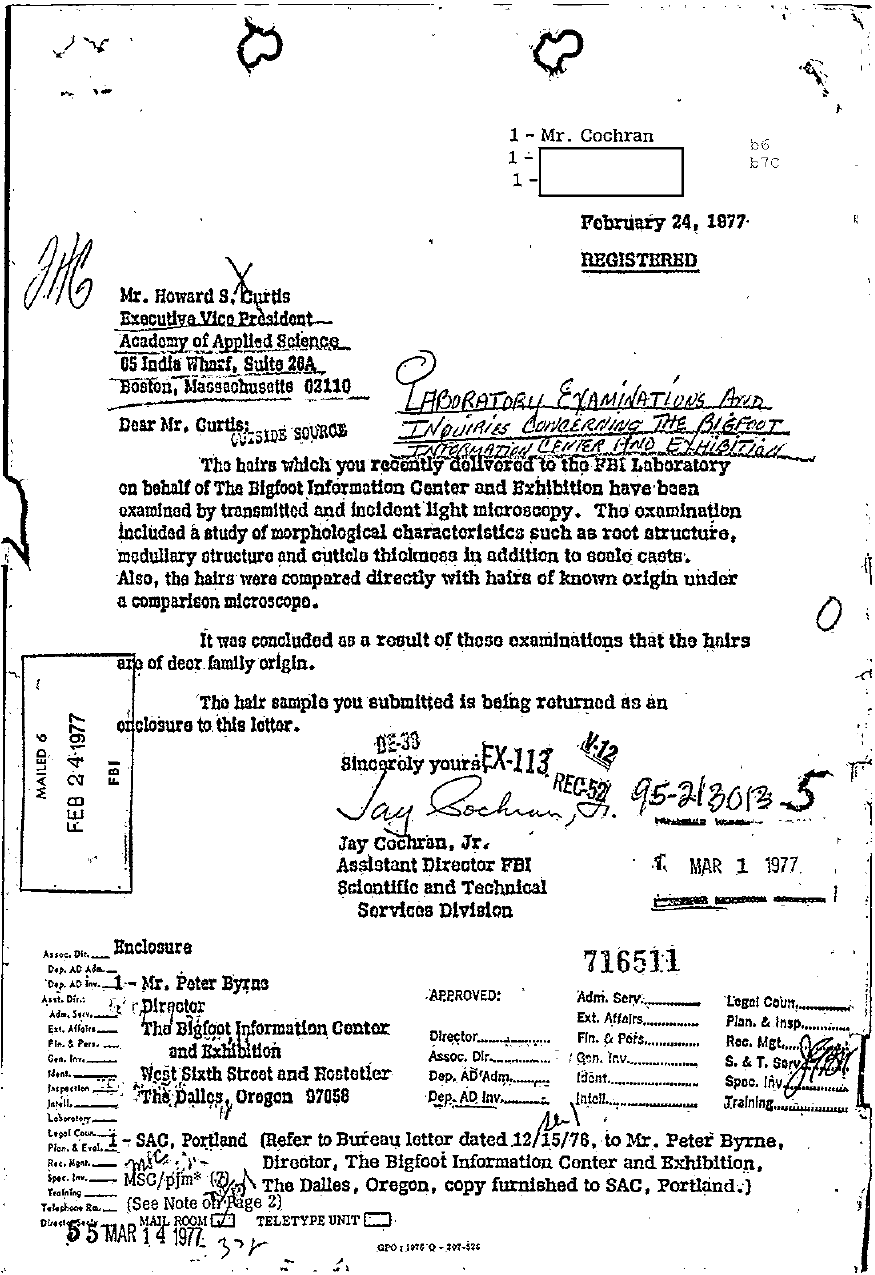
Federal Bureau of Investigation, Bigfoot file, result letter February 24, 1977, PDF p. 16. · Federal-authored result letter; this does not assert rights in the whole mixed-origin dossier.
Original source & record ↗
SOURCE MATERIAL
Open the original specimen photographs · PDF page 21 ↗FBI dossier; individual photographer not identified · Full official file linked. Standalone photograph reproduction remains on hold.
Original source & record ↗
It is worth opening the pages rather than stopping at the agency initials. FBI involvement sounds like a conclusion when compressed into a headline. In the correspondence it is a sequence of requests and decisions. Someone asks for help. The laboratory agrees to a limited job. A specimen receives an identification. Keeping those steps apart gives the story somewhere solid to stand.
Peter Byrne, director of the Bigfoot Information Center and Exhibition, wrote on November 24, 1976 asking for comparative analysis. He described about fifteen hairs attached to a tiny piece of skin that his organization could not identify. The request is on PDF page 2. His uncertainty was a reason to submit the material. It was not already a biological property of the animal that supplied it.
The distinction is plain enough and easy to lose: unidentified by the sender does not mean unidentifiable by everyone. It also does not make the sender dishonest. Taking an uncertain sample to a laboratory is a sensible next move. The test becomes useful precisely because its answer can disappoint the person who requested it. The sample, not the hope behind it, has to decide the result.
The December 15 acceptance letter, on PDF page 1, explains that laboratory work primarily serves criminal investigations. Exceptions may be made for research and scientific inquiry. This request received one. Permission to examine a specimen carries a specific authority: the laboratory will examine it. Stretching that into federal confirmation of Sasquatch would require a second document that this permission letter does not provide.
The answer describes microscopy and direct comparison with hairs of known origin. It identifies the submitted hairs as belonging to the deer family and says the sample is being returned. That is the result to carry forward. The letter supplies neither a species-level identification nor a DNA result. Its conclusion should not acquire either in the retelling. Keep the result at the level the letter gives it.
The specimen photographs offer a different kind of restraint. They let the reader see the material that went through this exchange. They are not portraits of its living source, and looking at them cannot substitute for reproducing the examination. Their value is documentary: the story has an object small enough to put beside a ruler, whatever the file is called.
One submission also sets the reach of the ending. A deer-family identification answers the question about these hairs. It cannot identify the source of every footprint, film or encounter associated with Bigfoot. Equally, those other claims cannot change this specimen into a primate. Neither conclusion can go beyond this submission.
This is a 1976–1977 exchange preserved in an online archive, not a new federal hunt. The documents reward attention because the result is narrower than the legend and firmer than the rumor. Open the request. Open the reply. Then keep the photograph beside them. The photographs show the specimen beside metric scales. The letter gives the result.