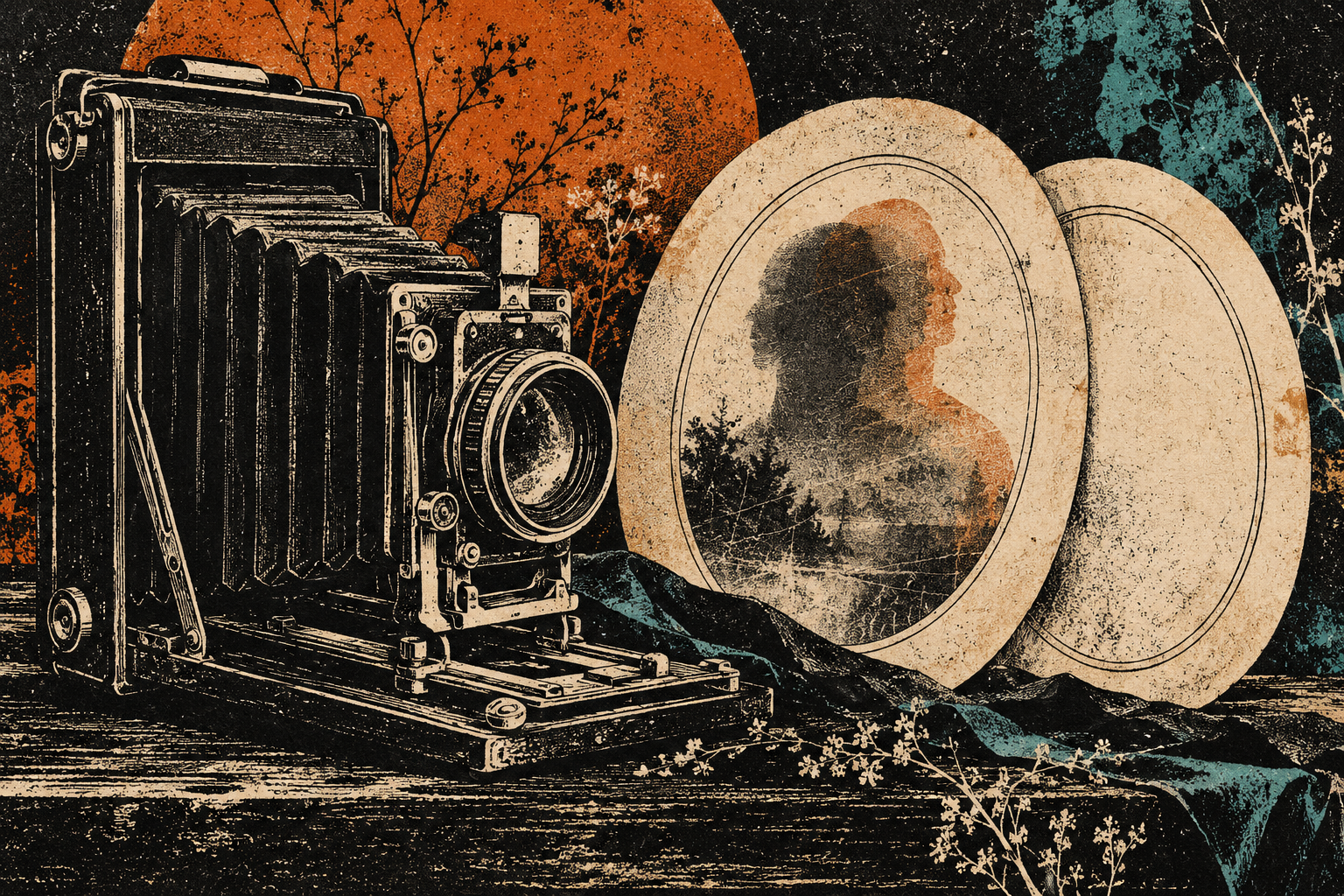
The woman has her arms crossed. Above her sits the faint image of a younger woman wearing flowers in her hair. Getty identifies neither person. Its record gives the print a date range, 1862–1875, a maker, William H. Mumler, and an object number: 84.XD.760.1.25.
SOURCE MATERIAL
Open the original Getty photograph ↗William H. Mumler; The J. Paul Getty Museum, Los Angeles · Getty-supplied museum record. Exact download rights were not independently verified; image is linked, not reproduced.
Original source & record ↗
The photograph measures 9.8 by 5.7 centimetres: an albumen silver print with a museum record. The title supplies a spirit. The record supplies a physical object. Getty's object record ↗
Mumler built a business around such images in the early 1860s. A Metropolitan Museum catalogue describes his support among Spiritualists, who believed the dead could communicate with the living. It also records a damaging complication: a supposed ghost appearing in two photographs was recognised as a living local resident. Mumler later opened a New York studio in 1868 and was arrested on fraud and larceny charges in 1869. Metropolitan Museum catalogue ↗
An arrest is not a conviction. This print's catalogue does not explain how its second figure was made. Two faces survive, neither named, long after the sales pitch. The photograph invites recognition. It cannot tell us whether the sitter recognised anyone.