
Four radar contacts. Two photographs.
A failed recorder. A tripped breaker. Four contacts on radar, but only one object in the photographs.
Read the case file ↗Twelve capsules rode out with the rubbish. Thirty-seven dark worlds resisted a single forecast. An enzyme was caught closing penicillin's rings, and desert lizards showed what hiding costs when food runs low. Below them, a 1950 FBI memo demonstrates how an unverified report can outlive its own dead end.
Read the reports ↓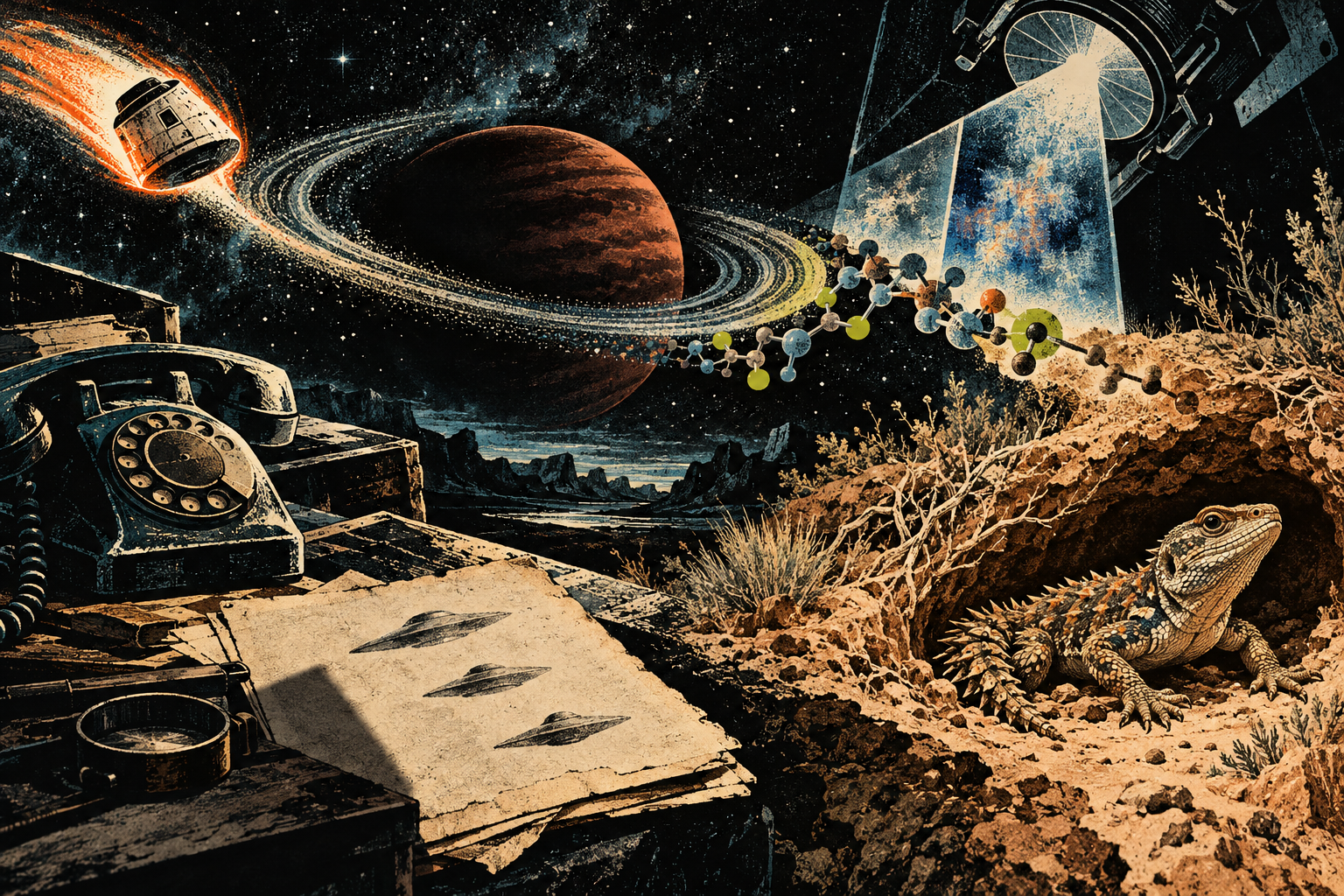
Four archive files and two extended reports. Equipment failures, disputed flight paths, a missing heading and a one-page memo. Each conclusion stays attached to the record that supports it.
A failed recorder. A tripped breaker. Four contacts on radar, but only one object in the photographs.
Read the case file ↗
The thermal clip seemed to show a plunge into the Atlantic. A reconstruction keeps the objects over land.
Read the case file ↗
A 34-second clip survived. The original recording and its metadata did not. That changes what can be calculated.
Read the case file ↗UFO / UAP · ARCHIVE FEATURE
Official record / unverified report
Memo dated March 22, 1950 · FBI account published March 25, 2013 · checked October 11, 2026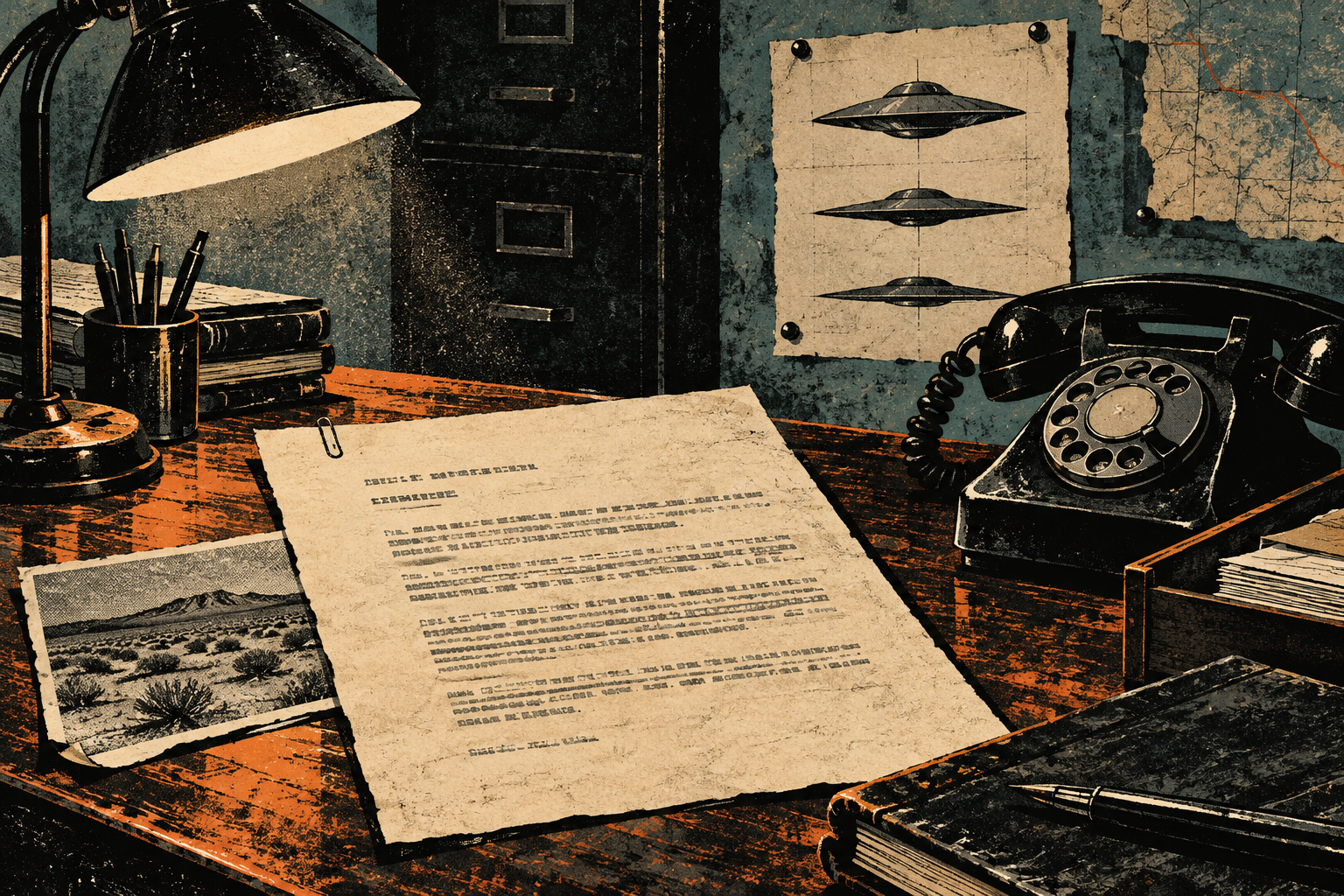
On March 22, 1950, Washington field-office chief Guy Hottel sent FBI headquarters a one-page memorandum. It relayed what an informant said an Air Force investigator had said: three circular craft had been recovered in New Mexico, each carrying three small human-shaped bodies.
The chain of custody ends there. The memo names no investigator, recovery team, location or physical evidence. Its final line says no further evaluation was attempted.
The FBI says it never investigated the claim and has no information that verifies a proposed hoax explanation either. The Bureau also says the memo was released in the late 1970s, predates the FBI Vault and has no established connection to the 1947 Roswell events.
The document proves that a report entered the files. It does not prove the report was true. What would change the case is evidence the page does not supply: named sources, contemporaneous recovery records, material remains or an independently documented investigation.
A dated archive feature, outside the 72-hour daily-news window. The memo is genuine; the claim it repeats is unverified.
UFO / UAP · REPORTED FEATURE
Official record
Archive case · May 19–20, 2025 · records reported March 20, 2026At 02:10 UTC, an FAA controller entered a report from flight PWA192: the crew said another aircraft was flying alongside it over Nevada. The log recorded no nearby radar target. Twelve radar files were withheld from the later public-records release.
The encounter appears in an FAA operations log obtained by John Greenewald’s Black Vault through a public-records request. In the log dated May 19, 2025, the 02:10 UTC entry records Gulfstream flight PWA192 reporting an object roughly 20 miles away, flying a parallel course near the SWR navigation beacon. The entry describes its appearance as fighter-like and records the crew’s report of flight level 310 and climbing.
The Black Vault published the records on March 20, 2026, alongside air-traffic-control audio. The FAA’s response letter says it withheld 12 radar files as sensitive security information.
That leaves a concrete report and an incomplete public record. The log establishes what the crew told controllers; it does not establish the object’s identity, measured performance, or origin. A radar non-detection alone cannot turn an unidentified aircraft into evidence of extraordinary technology.
A dated archive feature, outside the 72-hour daily-news window. The official log records a crew report; the object’s identity remains unestablished in these records.
These are dated archive features, not new sightings. AARO’s assessments are attributed findings; this publication has not independently reproduced its calculations. Unidentified objects remain unidentified where the evidence stops.
A haunting in boxes. A palace experiment. A photographer’s second face. Three new archive features, followed by the surviving sample from the Gef case.

Tenancy papers, séance transcripts, accusations. The house acquired a reputation; its archive lost its original order.
Read the case file ↗
Visitors recorded unusual experiences in particular rooms. The pattern was measurable. Its cause was another matter.
Read the case file ↗
Two women, neither named. A museum catalogue preserves the photograph long after the pitch about the dead.
Read the case file ↗Strange technology / space
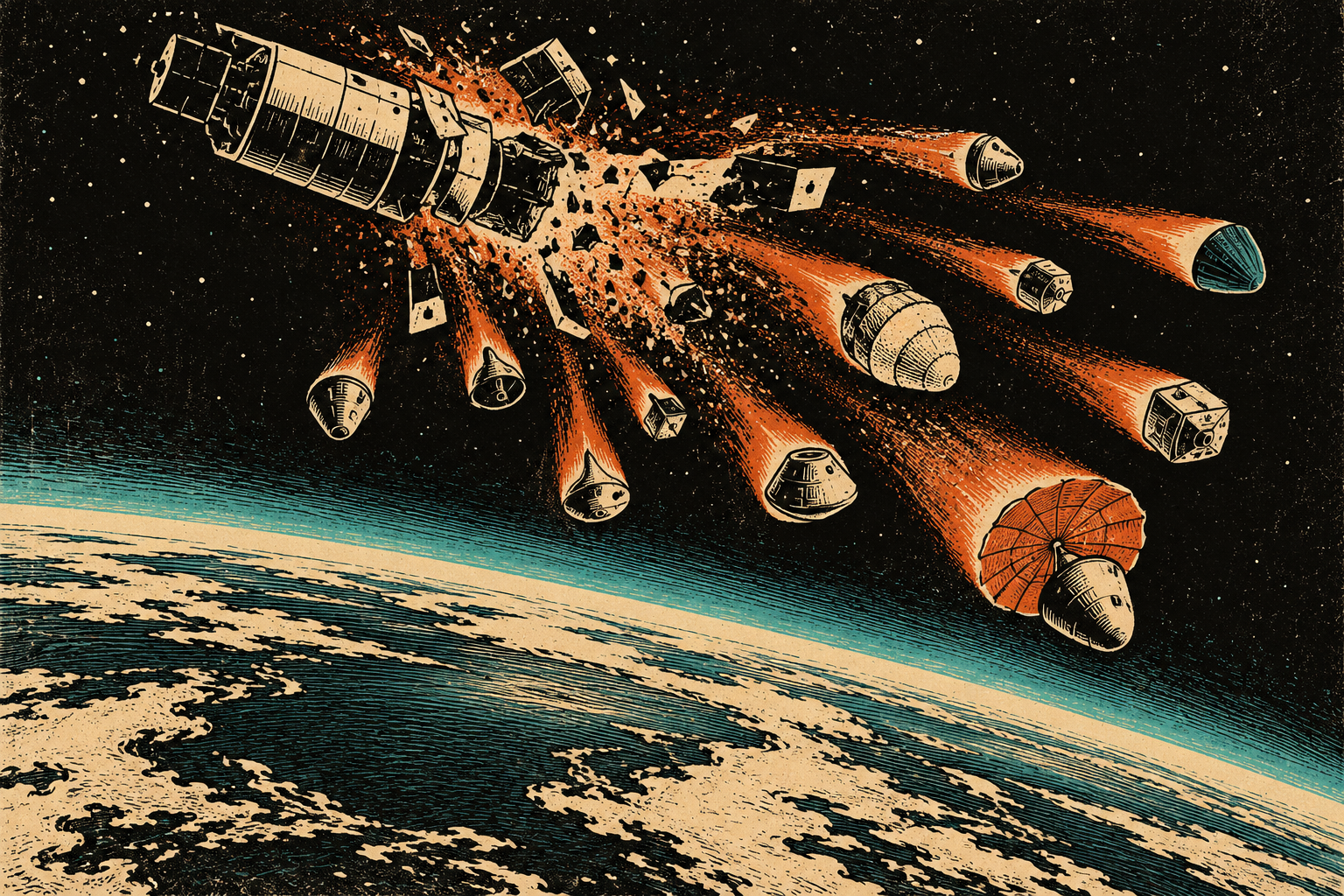
NASA says the departing Cygnus XL cargo spacecraft carried 12 experimental capsules for the University of Kentucky’s KREPE-3 mission. As the vehicle breaks apart, the capsules are designed to separate and transmit measurements by satellite. Their cargo includes a printed heat shield, stitched protective materials and an umbrella-like shield that unfolds to increase drag. Another capsule copies the shape planned for Dragonfly’s arrival at Saturn’s moon Titan. NASA’s October 9 report describes the intended measurements, not successful data return or proven upgrades. The disposal flight supplied the test range; the results still have to come home.
Read NASA Ames ↗Source published 2026-10-09 · checked 2026-10-11Strange science / astronomy

NASA’s SPHEREx telescope examined 37 brown dwarfs, objects too small to sustain the hydrogen fusion that powers stars. Their spectra show water, methane, carbon monoxide and carbon dioxide across a wide temperature range. Temperature did not settle the forecast: objects at similar temperatures produced distinctly different spectra, and models struggled where clouds thin and methane becomes prominent. NASA says thousands more brown dwarfs are being analyzed. The published sample is a census, not an explanation for the atmospheric variety.
Read NASA JPL ↗Source published 2026-10-08 · checked 2026-10-11Strange science / molecular machinery

Scientists used X-ray pulses to capture fleeting stages as isopenicillin N synthase assembled penicillin’s distinctive ring structure. They exposed tiny enzyme crystals to oxygen, then combined snapshots taken at different moments into a molecular movie. The October 9 study reveals intermediate structures that had resisted direct observation, including an early form with one completed ring. Water molecules inside the enzyme also help steer the chemistry. The work may inform enzyme engineering. It does not announce a new antibiotic or a treatment for drug-resistant infections.
Read University of Oxford ↗Source published 2026-10-09 · checked 2026-10-11Strange nature / animal behavior
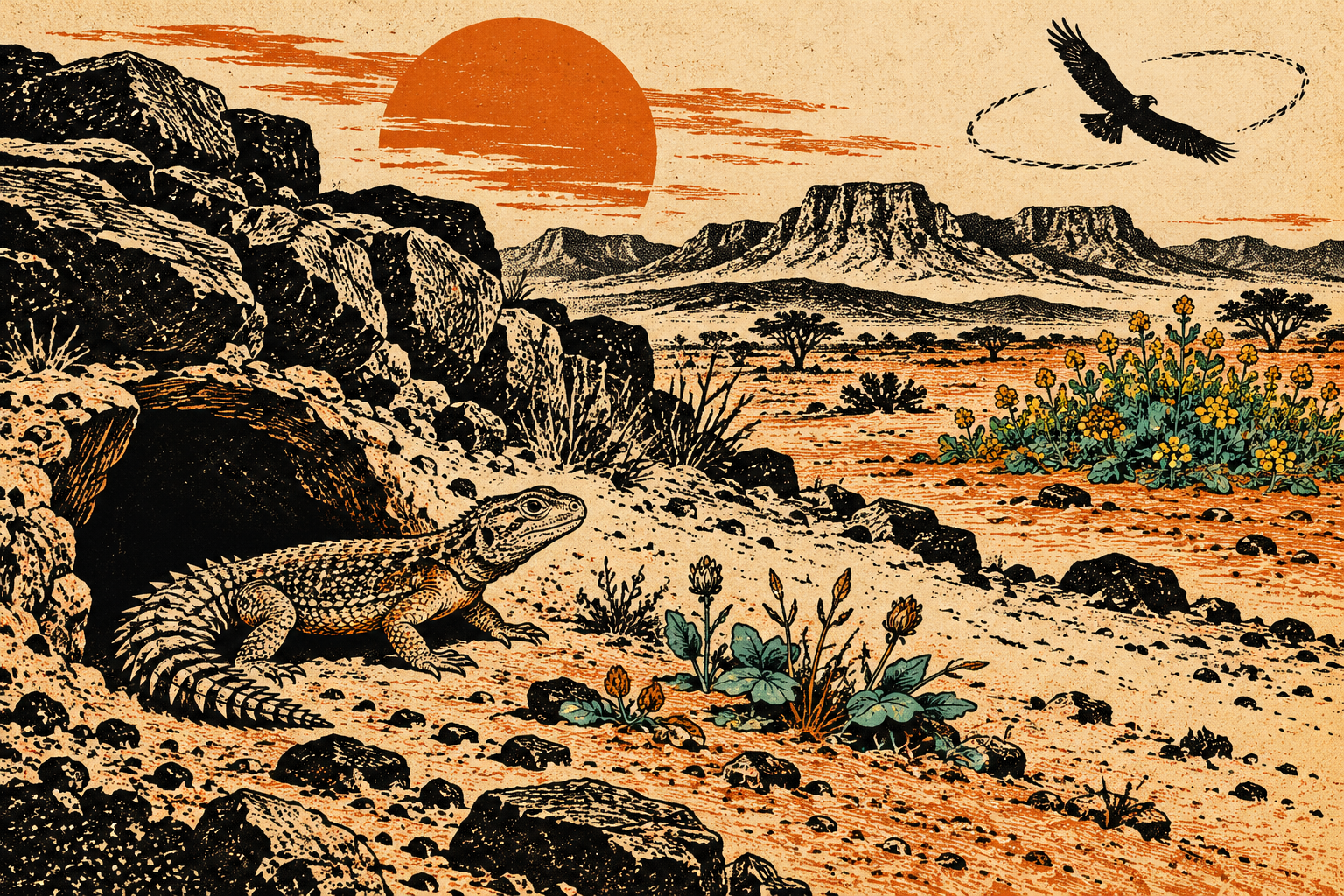
Researchers studying wild Indian spiny-tailed lizards compared habitats with different combinations of predator risk and food. Lizards in higher-risk patches hid longer and used smaller feeding ranges. Where food was scarce, those changes were linked to lower intake, poorer body condition and fewer offspring. Where food was abundant, lizards maintained intake without the same measured penalty. The October 9 study shows how danger can alter prey without a kill, and how local resources change that cost. It concerns one species in natural habitats, not every predator-prey system.
Read Ecology ↗Source published 2026-10-09 · checked 2026-10-11The landlord left a spare key beneath the mat. “Only use it if someone locks you out,” she said. That night, a key scraped inside the front door. I checked the hall. Empty. In the morning, the spare lay on my kitchen table, warm as a hand. Beneath it was a note in my handwriting: Let me back in.
A rotating collection of four short tales. Stories repeat; these are invented, not reported events.
The Daily Drift follows the odd corners of the news and brings back a few good stories. Short reports. Original words. The evidence stays attached.
Every factual news story links to the reporting behind it. Folklore and original fiction are clearly labeled. We write original summaries, keep important uncertainty intact, and hold stories we cannot verify.
Sasquatch is our fictional host and resident appreciator of human oddness. His field notes are playful commentary, not eyewitness reporting.
Real photography is credited and cleared for reuse. Original scratch-print illustrations bring the fictional night desk to life. Atmospheric imagery is labeled separately from news evidence. Grain, contrast and rough print texture are styling, never proof of a claim. Browse without JavaScript.